
THE HISTORY OF PADEL
"Who Invented It? Where Was It Born? and How Did It Arrive in Spain? And What Has Been Its Evolution in Spain and the Rest of the World."
The History of Padel
There are several versions regarding where and when padel was born; however, the version provided by the Spanish Padel Federation has been established, as it was recently confirmed by the International Federation.

Origins of Padel
World Padel Tour provides us with this curious documentary where we will learn more about the history of padel. From the oldest court in the world, located in Acapulco, we review the first steps of the 20×10 sport. With the
participation of Viviana Corcuera, wife of Enrique Corcuera, Ignacio Soto Borja, notary and WPT ambassador, and Diego de La Torre, a padel pioneer, we delve into the beginnings of a sport that is crossing borders.
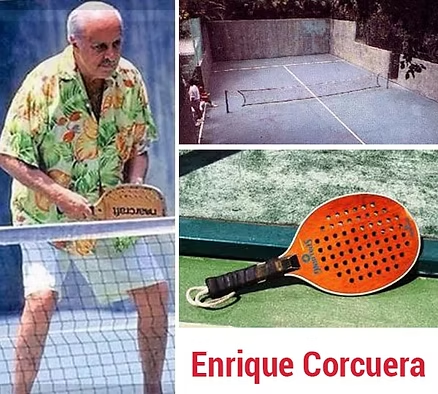
Who invented padel?
Enrique Corcuera, creator of padel. Enrique Corcuera is considered the inventor of padel. Enrique Corcuera, in love with the fronton at his home in Las Brisas, decided to incorporate a wall about three meters high on the wall opposite the one he already had, also placing a net in the middle and closing its sides with four medium-height walls.
Where and How was Padel born?
Padel was born in Acapulco (Mexico) in 1962, when a contractor named Enrique Corcuera adapted a plot of land on his estate of 20 x 10 meters, placing walls at the back and sides so that vegetation would not invade the court at his home in Las Brisas.
What was the first padel court like?
What the "official chronicle" does not mention (said personally by Don Enrique) is that he ordered the wall opposite the fronton wall to be built because the black ball they played with, once it passed the players' defensive line, would end up on the neighbor's property, making the game dynamics tedious.

First REGULATIONS in the History of Padel
The first regulations were drafted by Enrique's wife, Viviana, a former Miss Argentina, who edited them and gave them to her husband as a birthday present.
History of Padel in Spain
Who introduced Padel to Spain? A Spanish friend of Mr. Corcuera, who used to travel to Mexico quite often, brought the idea to Marbella. This man, named Alfonso Hohenlohe, built a court at the Marbella club he owned. It was thanks to Prince Alfonso de Hohenlohe, who built two "courts" in 1970 at the Marbella Club Hotel, shortly after sharing several summers in Acapulco where he had the opportunity to learn about the new game at his friend Enrique Corcuera's house.
First Padel Court in Spain:
Prince Alfonso built his courts with some modifications. He partially integrated a wire fence instead of side walls. These courts hosted the famous "Pro-Am" tournaments during the 80s and 90s,
sponsored by the "Smith & Smith" stores from Las Arenas, Bilbao, Spain, owned by Mr. Julio Alegría Artiach, one of the most important figures in the history of Padel due to his vision, promotion, investment, and life dedicated to the dissemination and development of the sport at all levels.
Many polo players coming from Argentina learned what padel was in Marbella, and when they returned to Argentina, they began to spread padel as a fun and easy game with inexpensive facilities.

Consequently, padel began its expansion in Argentina and Spain. In Spain, Padel began to expand to the major cities and sports clubs of Madrid, Barcelona, Andalusia, Galicia, Catalonia, etc.
The success achieved in a short time attracted prominent tennis figures like Manolo Santana, who began organizing tournaments and promoting padel throughout the Costa del Sol, where several clubs started building their own courts.
The necessary infrastructure for the practice of this sport was created throughout the country, and a National Tournament Circuit was organized in the most prestigious clubs in Spain. After this, padel began to grow boundlessly due to the Federation and the appearance of some Padel championships broadcast on television (few and on regional channels).
Padel in ARGENTINA:
Padel arrived in Argentina in 1969.
The first courts in Argentina were built at the Club Tortugas and the Ocean Club of Mar del Plata. In Los Acantilados, Tedy Pini built a "Parador" with a court, also at the Estancia La Biznaga of the Blaquier family and at Haras Vacación and El Turf of the Menditeguy family.
The La Marca restaurant in Playa Grande (Mar del Plata) built an indoor court at the back. In this way, and also in private homes, its practice began.
In 1982, there were no more than 12 courts in all of Argentina, and it is precisely that year when Padel began its development to become what has been called a true social phenomenon, giving rise to the current development and implementation of our sport.
In the City of Buenos Aires, the San Juan Tennis Club was inaugurated; at the suggestion of some founding members like the Aubone brothers, two Padel courts were built, which would become historic in the launch of Argentine Padel.
In 1984, the Club San Jorge was inaugurated with 14 Padel courts in San Isidro, becoming the club where the best players in the country gathered.
Padel invaded the main cities of the entire Province of Buenos Aires and other provinces and cities like Mendoza, Rosario, Paraná, Corrientes, Bariloche, Neuquén, as well as the entire Atlantic coast. In July 1987, the Platense Paddle Association (APPTAS) was constituted, which is the first formally constituted institutional entity related to our sport in the world.
1988 – The A.P.A. (Argentine Padel Association) is created and recognized by the Argentine Olympic Committee (COA).
1989 – SANE launches the first rubber racket in the world. (Approved by the APA).
In 1991, Padel was considered the second most played sport in Argentina after football, and it even managed to surpass it in sales in sports shops.
Padel and Institutions in Spain:
Regarding the Spanish Padel Association, it was registered using the acronym P.A.D.E.L., which stood for: "promotion of sporting, educational, and recreational activities" (in Spanish). 1990 – The FEP (Spanish Padel Federation) is born.
On July 25, 1991, the International Padel Federation was constituted in Madrid, with the presidency falling to a Spaniard, Julio Alegría Artiach. In May 1993, padel took a decisive step for its consolidation: the Higher Sports Council agreed to its recognition as a sporting modality.
Since 1993, the International Championships of Spain have been held in Madrid, with the presence of the best players in the world. The Professional Padel Circuit was called Padel Pro Tour for 7 years, until 2013 when players signed with new organizers, World Padel Tour.
First Padel World Championship:
The finals of the first Padel World Championship were played on the island of La Cartuja, in Seville, on a court called "Palacio de Cristal" (Crystal Palace) that arrived from Argentina. National teams from eight countries participated: Argentina, Spain, France, England, Italy, Mexico, Paraguay, and Uruguay. Argentina was crowned World Champion in both men's and women's categories.
History of Padel in Other Countries:
Although Padel was born in Mexico in 1962, it was only in 1991 that the Mexican Paddle Association was founded. On April 27, 1992, the Mexican Paddle Federation was constituted. Padel is spreading across different European countries. Today, France, Italy, Great Britain, Belgium, Austria, and Germany have already formed their respective federations.
Curious Difference in REGULATIONS between Spain and Argentina: Before 1997, there were notable differences: In Spain, the "serve and volley" game existed, surfaces were synthetic grass (slower), and there was the famous "pico" (a projection in the wall-fence union). The name was Hispanicized as "PÁDEL". In Argentina, you could not volley the return of the serve, surfaces were usually smooth concrete, there were no "picos", and the name used was the original "PADDLE".

1997 – Unified Regulations With the unification of rules in Barcelona in 1997, the sport was definitively named Padel. Today, surfaces are mostly synthetic grass or painted concrete.
What is padel?
I advise you to visit this link if you want to know what padel is and learn everything about this sport.
Padel is the only sport that combines the best elements of tennis, racquetball, and squash. It is frequently practiced on concrete surfaces, but there are courts with synthetic grass and supreme court floors (currently, synthetic grass has become the standard). Padel is played almost entirely in complexes exclusive to this sport. There are clubs with a single court, up to complexes with 20 indoor courts (courts can be indoor or outdoor).
Source: Padel Star Editor: Raul D. Martin


Comments